
Read the price for the parcel your supplier will ship
Use the current service, price category, origin, destination, weight and package details. USPS publishes separate retail and commercial tables, so a retail counter price is a poor stand-in for a supplier's commercial postage or its all-in shipping quote. [2]
One concrete example: the final October table lists a two-pound USPS Ground Advantage commercial parcel to Zone 5 at $10.50. The July 12, 2026 price file lists the same entry at $9.95. That is a $0.55 increase in the published weight-based postage price. [2, 3] It is an example for that entry, not a universal surcharge or a quote from Shopify or your supplier. All dollar amounts here are USD.
Keep the rate category intact when comparing prices. A cubic price, a different service or a parcel subject to additional fees needs its own comparison. USPS's Ground Advantage table also specifies dimensional-weight pricing for parcels over one cubic foot, using the greater of actual and dimensional weight. [2] Ask for the package your supplier actually uses rather than estimating from the product's unpacked weight alone.
Turn order volume into parcel volume
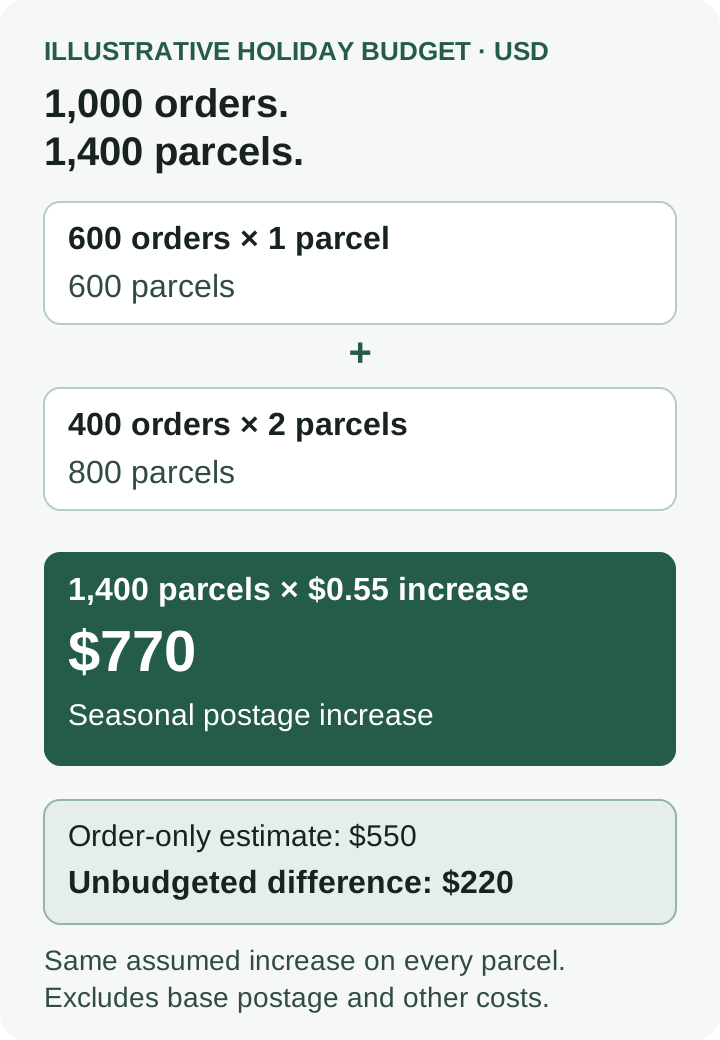
Consider an illustrative forecast of 1,000 customer orders. Assume 600 orders produce one parcel each and 400 produce two parcels each. Also assume every parcel has a $0.55 seasonal increase, using the price difference above as the scenario input. These are invented planning quantities, not merchant results.
- 600 one-parcel orders produce 600 parcels
- 400 two-parcel orders produce 800 parcels
- The total is 1,400 parcels, or 1.4 parcels per customer order
The incremental postage budget is 1,400 × $0.55 = $770. Counting only customer orders would produce 1,000 × $0.55 = $550, leaving $220 unbudgeted. The average seasonal increment is $0.77 per customer order in this scenario.
This $770 covers only the assumed seasonal change. It excludes the underlying postage, packaging, supplier handling, returns and other expenses. If the suppliers absorb the increase or their agreed prices do not change, the retailer's incremental cost will differ.
For a real forecast, group parcels by supplier, service, destination zone and relevant weight or size band. Multiply each group's expected parcel count by its confirmed increase, then add the groups. Use a single average only when it reflects that mix. Include replacement or return shipments separately when your store expects to fund them; do not quietly treat every customer order as exactly one outbound parcel.
Keep checkout revenue and supplier shipping costs visible
Shopify's shipping rates determine what customers pay at checkout. They can be flat, free or carrier-calculated. [4] Your supplier's charge is another part of the calculation, governed by the terms you have agreed.
Compare three amounts for the same order:
- Shipping revenue collected from the customer after any discount
- Shipping and handling charged by every supplier involved
- Any additional label or packing cost your own team pays
If a supplier price already includes shipping, account for that cost once within the supplier purchase. Do not add an estimated postage line again. If the invoice combines goods and shipping without a breakdown, record that limitation before calling the difference a shipping margin.
To estimate order contribution, subtract supplier goods, shipping and other variable costs from merchandise revenue plus shipping revenue. Define the costs consistently so two product groups can be compared fairly. A shipping-only gap leaves out costs needed to judge the whole order. With everything else unchanged, the scenario's $0.77 increase reduces contribution by $0.77 per order.
If you are changing the checkout configuration itself, our market-driven shipping article explains the different ways Shopify can combine rates. Use the observed checkout result in the budget rather than assuming it equals the suppliers' total cost.
Choose a response that fits the affected carts
Shopify's shipping-strategy guide explains the trade-off: flat rates need cost estimates, free shipping needs funding elsewhere, and carrier-calculated rates depend on accurate shipment details. [5] A seasonal increase can therefore lead to different decisions for different carts.
Absorbing the increase may suit an offer with enough contribution remaining. Put the expected subsidy into the promotion budget, including the likely parcel mix. A customer shipping charge can also help cover costs, but base any change on the full shipping forecast and the customer experience you intend to offer.
Review free-shipping thresholds using actual product combinations. A higher-value mixed-supplier cart can still create another full postage charge. The added item's contribution needs to cover that extra shipment and other added costs, not just the temporary $0.55 in the example. Raising the threshold without examining the carts that cross it can leave the same cost problem in place.
Merchandising offers another option to investigate. A promotion built from products one supplier can pack together may have a different parcel cost from a cross-supplier bundle. Confirm the supplier's packing arrangement, available stock and shipping quote first. Two items from the same supplier can still require separate packages.
Refresh the forecast from actual charges
Ask each shipping supplier whether its current quote includes the temporary rate change, packaging and handling. Confirm the service, destination coverage and the date on which its quote will be reviewed. Compare on the same currency and tax basis. A current quote may already include the holiday adjustment; adding it again would overstate costs.
After the first holiday orders ship, compare the expected parcel mix with the actual packages and charges. If more orders split than planned, revise that assumption before scaling the promotion. Investigate price differences using the actual parcel details, keeping a changed package size separate from a seasonal price increase.
Postal Explorer gives this change an end date in January. [1] Use that as a point to obtain fresh rates and supplier quotes, rather than assuming every shipping cost will return to its previous amount. A useful holiday budget follows the costs your store actually pays: parcels, agreed supplier charges and the customer shipping offer together.
Sources
Sources checked October 12, 2026. USPS figures are published postage-table examples; obtain current quotes for the actual parcels and shipping accounts. Shopify Help Center pages are maintained documentation. Forecast quantities and the $770 budget example are illustrative calculations.
- USPS Postal Explorer: Time-Limited 2026 Price ChangeUnited States Postal Service · Checked
- USPS: Final October 2026 Notice 123 price listUnited States Postal Service · Commercial Ground Advantage, page 15 · Checked
- USPS Postal Explorer: Price and SKU File ArchiveUnited States Postal Service · July 12, 2026 CSV price files, USPS Ground Advantage Comm.csv · Checked
- Shopify: Shipping ratesShopify · Checked
- Shopify: Creating a shipping strategyShopify · Checked